
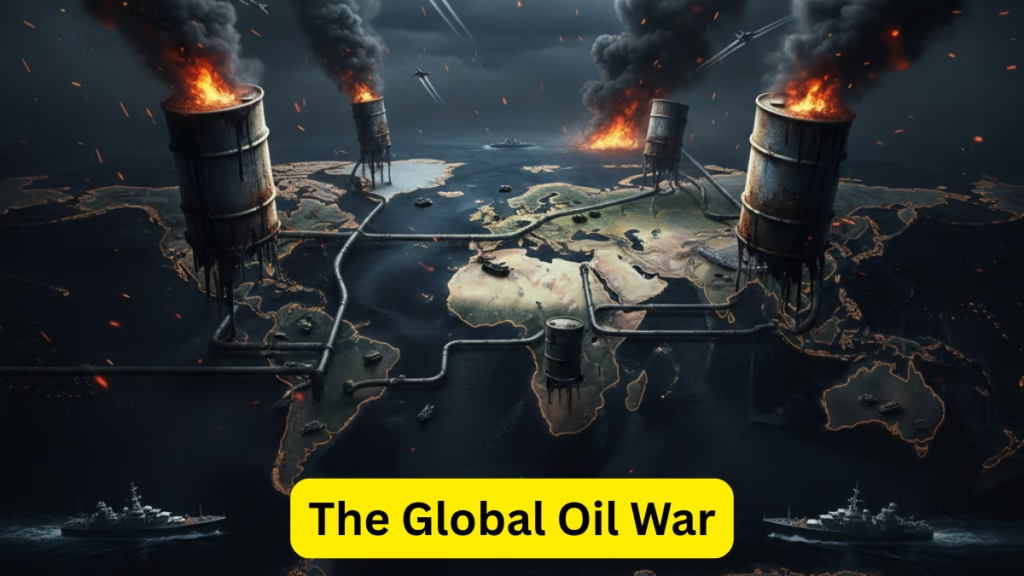
How Global Oil or Black Gold Fuels Power, Politics, and Conflict Across Nations
Introduction: Oil Is Not Just Fuel — It Is Power
Oil is often called black gold, but in reality, it is much more than a natural resource.
It is power, influence, economic control, and in many cases, a reason for war.
From the Middle East to Eastern Europe, from Africa to South America, oil has shaped the rise and fall of nations. Governments have collapsed, wars have erupted, and alliances have shifted — all because of oil.
This is not just an energy story.
This is a global geopolitical battle.
In this article, we explore:
- Why oil is so powerful
- How countries fight for control over oil
- The role of the US, Russia, China, and the Middle East
- How oil wars affect the global economy
- Why these conflicts impact every human on Earth
Why Oil Controls the World
Oil powers:
- Transportation (cars, ships, planes)
- Industries and factories
- Military operations
- Plastics, chemicals, fertilizers, medicines
- Global trade and logistics
Without oil:
- Planes stop flying
- Supply chains collapse
- Food prices skyrocket
- Economies fall into chaos
That’s why energy security = national security.
Any country that controls oil controls:
- Its economy
- Its military strength
- Its geopolitical influence
Where the World’s Oil Is Located
The majority of global oil reserves are concentrated in a few regions:
Major Oil-Rich Regions
- Middle East (Saudi Arabia, Iran, Iraq, UAE, Kuwait)
- Russia
- United States
- Venezuela
- Africa (Nigeria, Libya, Angola)
Ironically, many oil-rich countries suffer from:
- Political instability
- Foreign interference
- Internal conflict
This phenomenon is often called the “Resource Curse.”
The Middle East: The Epicenter of Oil Wars
The Middle East holds nearly half of the world’s proven oil reserves.
It is also the most conflict-ridden region on Earth.
Iraq War: Oil Behind the Curtain
The 2003 Iraq War was officially justified by claims of weapons of mass destruction.
But no such weapons were ever found.
What Iraq did have was:
- One of the world’s largest oil reserves
After the invasion:
- Western oil companies gained contracts
- Iraq’s infrastructure collapsed
- Millions were displaced
This war changed the global oil landscape forever.
Iran and the Strait of Hormuz: A Global Choke Point
Iran controls access to the Strait of Hormuz, a narrow waterway through which 20% of the world’s oil supply passes.
Any disruption here means:
- Immediate oil price spikes
- Global market panic
- Economic shockwaves
This is why Iran remains at the center of global oil politics, sanctions, and military tension.
The United States: Oil, Dollar, and Global Control
The US plays a unique role in the oil war.
The Petrodollar System
Most global oil trade is conducted in US dollars.
This means:
- Countries need dollars to buy oil
- Demand for the dollar remains high
- The US maintains financial dominance
Any country that challenges this system faces:
- Sanctions
- Political pressure
- In extreme cases, military intervention
Oil and the dollar are deeply connected.
Russia: Energy as a Weapon
Russia is one of the world’s largest oil and gas exporters.
Its strategy:
- Supply energy to Europe
- Gain political leverage
- Use energy pricing as pressure
After the Ukraine war:
- Western sanctions targeted Russian oil
- Global oil prices surged
- Russia redirected exports to Asia
This reshaped global energy alliances.
China: Silent Expansion Through Energy
China is the world’s largest energy consumer but lacks sufficient oil reserves.
Instead of wars, China uses:
- Long-term oil contracts
- Infrastructure investments
- Strategic partnerships
China’s oil diplomacy spans:
- Africa
- Middle East
- Central Asia
Its goal is simple: energy security without open conflict.
Africa and South America: Hidden Battlefields
Countries like:
- Venezuela
- Libya
- Nigeria
Possess massive oil reserves but struggle with:
- Corruption
- Foreign influence
- Political instability
Oil wealth often benefits elites while citizens suffer — another example of the resource curse.
How Oil Wars Affect the Global Economy
When oil conflicts erupt:
- Fuel prices rise globally
- Inflation increases
- Transportation costs surge
- Food prices go up
A war thousands of miles away can:
- Raise grocery prices
- Increase electricity bills
- Reduce purchasing power
Oil wars are not distant problems — they affect everyone.
The Role of Sanctions: Modern Economic Warfare
Modern oil wars are often fought without bullets.
Weapons include:
- Economic sanctions
- Trade restrictions
- Banking system bans
- Technology denial
These measures can:
- Collapse national economies
- Trigger protests
- Change governments
Sanctions have become a powerful tool in oil geopolitics.
Is the World Moving Away from Oil?
Electric vehicles and renewable energy are growing, but:
- Aviation still depends on oil
- Shipping relies on oil
- Petrochemicals remain essential
Oil demand may slow, but it won’t disappear anytime soon.
Which means:
👉 Oil conflicts will continue — only their form will change.
The Future of Global Oil Conflicts
Future oil wars will likely involve:
- Cyber attacks on energy infrastructure
- Economic pressure instead of military invasion
- Control of energy supply chains
- Strategic alliances
Energy will remain the foundation of global power.
Conclusion: Oil Wars Shape the World We Live In
Oil has powered modern civilization, but it has also fueled conflict, inequality, and suffering.
As long as oil remains central to:
- Economies
- Militaries
- Global trade
The fight for control will continue.
Understanding oil geopolitics is not optional anymore —
It is essential to understanding our future.

